Spray Foam Roofing vs. Traditional Roofing: Which Is Right for Your Arizona Property?
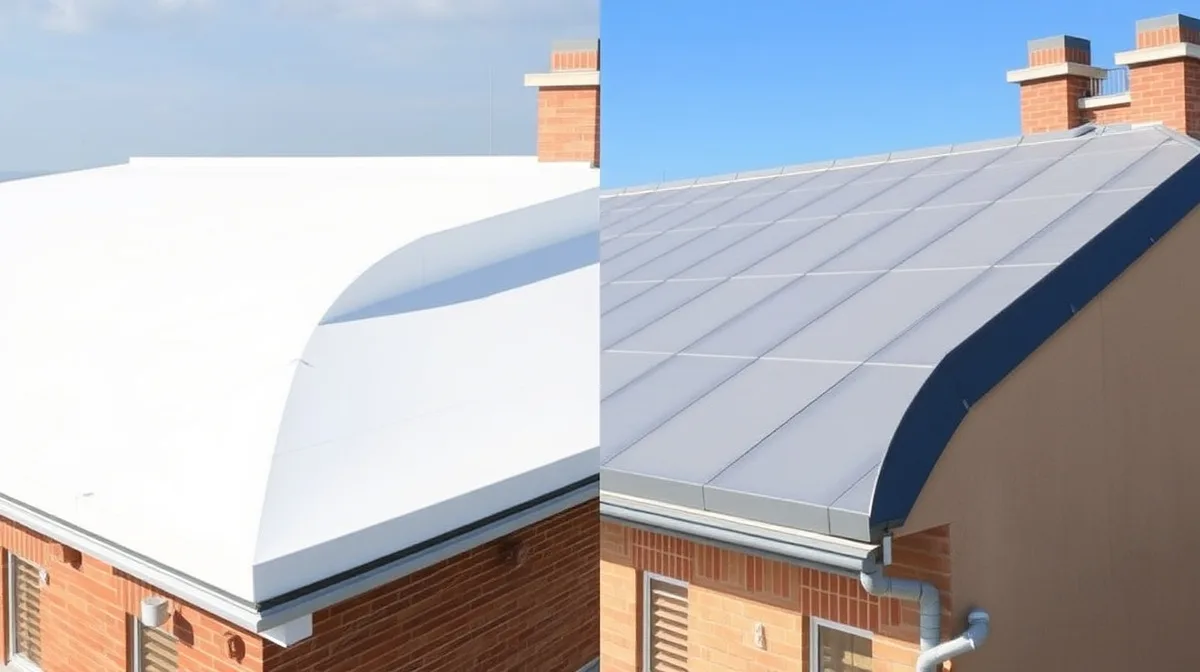
If you own or manage a flat or low-slope building in the Phoenix or Tucson area, you've got roofing options: TPO, EPDM rubber, built-up (tar and gravel), and spray polyurethane foam (SPF), with shingle still showing up on pitched sections of residential homes. Each of these systems can technically keep water out. Not all of them are built for what Arizona actually throws at a roof — 150°F+ surface temperatures, months of relentless UV, and monsoon downpours that test every seam and drain. Here's how they actually stack up.
Spray Foam (SPF): The Seamless Baseline
SPF is sprayed on-site as a liquid that expands into a rigid, closed-cell foam, then sealed under a protective silicone or acrylic topcoat. Because it's applied as a continuous membrane rather than assembled from sheets or rolls, there are no seams, laps, or fasteners for water to find. It also self-tapers, meaning a crew can build in proper slope-to-drain on a dead-flat commercial deck instead of fighting standing water for the life of the roof. Installed correctly, SPF roofs are commonly rated 40-50+ years, with the topcoat — not the foam itself — as the wear item that needs recoating roughly every 10-20 years to keep the system under warranty.
TPO: Reflective, But Seamed
TPO (thermoplastic polyolefin) is a single-ply membrane installed in large sheets, heat-welded at the seams. It's popular because it ships white and reflective right out of the box, and material costs run lower than a full SPF install. The tradeoff is those seams — hundreds of linear feet of heat-welded joints on a typical commercial roof, every one a potential failure point as the membrane expands and contracts through Arizona's daily heat swings. TPO doesn't add meaningful insulation value on its own (it's paired with separate rigid board insulation underneath), and it doesn't self-correct ponding water the way tapered foam does. Typical lifespan runs 15-20 years, shorter than SPF, with membrane replacement — not simple recoating — as the end-of-life fix.
EPDM: Durable Rubber, Weak Reflectivity
EPDM (a synthetic rubber membrane, usually black) has a long track record for durability and is genuinely puncture-resistant. Its big weakness in a desert climate is reflectivity — black EPDM absorbs heat rather than bouncing it, which works against you on a summer cooling bill in a market where roof surface temps regularly blow past 150°F. White EPDM exists but costs more and is less common. Like TPO, it's a seamed system: adhered or mechanically fastened sheets with taped or glued joints that are the first thing to fail as the roof ages. Lifespan is comparable to TPO, in the 15-25 year range, and a seam failure or puncture generally means patching a specific membrane section rather than a clean spot-fix.
Built-Up Roofing: The Old Standby
Built-up roofing (BUR) — alternating layers of asphalt/bitumen and reinforcing fabric, topped with a gravel ballast — is the classic "tar and gravel" system still found on a lot of older Arizona commercial buildings. It's heavy, which adds real structural load, and it's genuinely tough against foot traffic. But BUR is also the least energy-efficient option on this list: dark asphalt and gravel absorb and hold heat instead of reflecting it, and the gravel ballast makes it difficult to even inspect the membrane underneath for damage without disturbing it. Multi-layer BUR systems typically last 15-20 years before needing full replacement, and leaks can be genuinely difficult to trace because water often travels laterally under the gravel before it shows up as a stain inside.
Shingle: Fine for Pitched Sections, Not Flat Ones
Asphalt shingle remains standard on the pitched sections of Arizona homes — gable roofs, dormers, sloped entry porches — and there's no reason to replace shingle with foam where a roof is already designed to shed water by pitch alone. Shingle isn't engineered for flat or low-slope applications, though; it depends on slope to move water off fast, and on a flat deck it will pond, curl, and fail quickly. Where SPF earns its place on a residential property is the flat or low-slope sections some AZ homes have — patio covers, additions, casitas, and the many mid-century and desert-contemporary homes built with a flat main roof plan.
Cost Comparison
- New SPF roof install: roughly $6-$12/sq ft for residential and light commercial, $3.50-$8/sq ft for larger commercial projects.
- SPF recoat (silicone/acrylic, on an existing foam roof): roughly $3-$5/sq ft — far cheaper than any full tear-off.
- TPO, EPDM, and BUR installs are frequently quoted at a lower up-front price per square foot than new SPF, but none of them offer a comparably cheap mid-life renewal — when the membrane wears out, you're generally paying for a full replacement, not a recoat.
- All figures are typical ranges, not fixed quotes — actual pricing depends on roof condition, access, and square footage, which is why a free on-site estimate is the only way to get a firm number.
Repairability: Foam's Real Advantage
This is where the systems diverge most in practice. TPO, EPDM, and BUR are all seamed or layered systems — when a leak shows up, the fix usually means finding the failed seam, lap, or fastener, and if a section of membrane has deteriorated, replacing that whole section is often the only reliable option. SPF has no seams to fail in the first place. A puncture, a hail ding, or a spot of wear can typically be cleaned, patched with foam, and recoated right at that location, without touching the rest of the roof. For a facility manager weighing long-term maintenance cost, that's the difference between a targeted afternoon repair and a multi-day membrane section replacement.
Energy Efficiency and Reflectivity
SPF does double duty that seamed systems can't match: it has the highest R-value per inch of any common roofing insulation, and its topcoat is applied reflective (white or light-colored) to cut solar heat gain. TPO also ships reflective but relies on separate insulation board underneath. EPDM and BUR are typically dark-colored and absorb heat, working against Arizona's cooling loads unless you pay extra for a white membrane or a reflective coating add-on. For a building where cooling is the single biggest utility expense for half the year, SPF's combined insulation-plus-reflectivity profile is hard for the alternatives to match.
Best-Fit Scenarios at a Glance
- Flat or low-slope commercial building, especially with ponding water history: SPF, for tapered drainage and seamless membrane.
- Aging BUR or gravel roof due for replacement: SPF re-cover is often possible, avoiding a costly tear-off and landfill waste.
- Existing SPF roof with a chalking or thinning topcoat: recoat, not full replacement — the cheapest way to reset the warranty clock.
- Pitched residential sections (gables, dormers): shingle remains the right call — SPF isn't meant to replace a system that already sheds water by design.
- Budget-constrained short-term ownership horizon: TPO or EPDM may pencil out lower up-front, with the tradeoff of a full membrane replacement, not a recoat, at end of life.
The right system ultimately depends on your roof's slope, current condition, and how long you plan to own the property. An on-site inspection is the only way to get a real comparison for your specific building — call 844-967-5247 or request a free estimate to see how SPF stacks up against what's on your roof today.
Frequently asked questions
For Arizona's flat and low-slope buildings, SPF has real structural advantages: no seams to fail, built-in tapered slope-to-drain, and the highest R-value per inch of the common systems. TPO and EPDM are legitimate, widely used systems too — they just don't match foam's insulation value or its spot-repair advantage over a seamed membrane.
Often, yes — SPF can frequently be sprayed as a re-cover directly over a compatible existing roof, avoiding a full tear-off. Whether re-cover is appropriate depends on the substrate's condition and how many existing layers are already on the deck, which is exactly what an on-site inspection is for.
Seamless systems have the advantage here. SPF's monolithic membrane and tapered drainage move monsoon downpours off the roof without relying on seams or laps that can be stressed by wind-driven rain and repeated heat-cycling, which is where seamed systems like TPO, EPDM, and BUR are more vulnerable over time.
Ready for a free roof quote?
Tell us about your roof and we'll build a clear, no-pressure quote.