Residential Spray Foam Roofing for Homes
A seamless, fully-adhered foam roofing system built for the flat and low-slope sections of Arizona homes — additions, patio covers, casitas, and full ranch or desert-contemporary roofs.
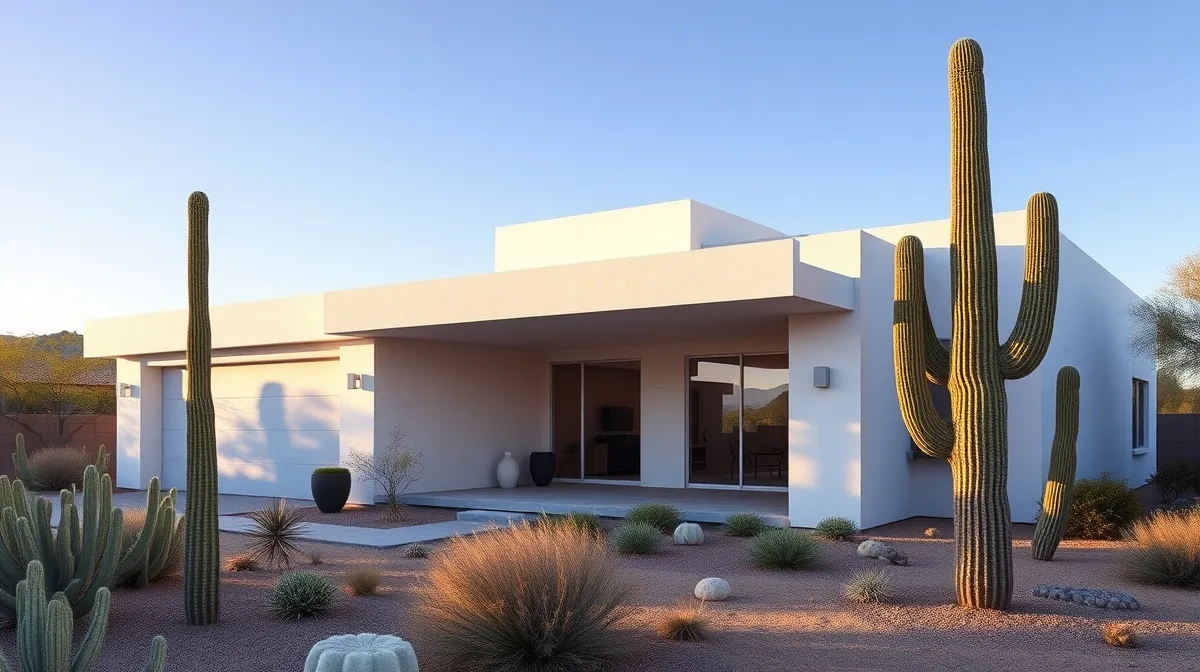
If you own a ranch-style, mid-century, or modern desert-contemporary home in the Phoenix or Tucson area, there's a good chance at least part of your roof is flat or low-slope — a great room addition, a covered patio, a casita, or the whole primary structure. Traditional shingle systems aren't built for that geometry; they're designed to shed water down a pitch, and on anything under about a 2:12 slope they're prone to seams failing, granule loss from UV exposure, and ponding at low points. Spray polyurethane foam (SPF) was built for exactly this condition. It's sprayed on as a liquid, expands into a fully-adhered, seamless membrane that follows every contour of your roof deck, and cures into a rigid foam layer with a protective elastomeric topcoat over it.
For Arizona homeowners specifically, that seamless quality matters more than it does almost anywhere else in the country. Our summers push unshaded roof surface temperatures well past 150°F, and the UV load on an unprotected or aging membrane is relentless. SPF's high R-value insulates the living space beneath it, and the reflective topcoat we apply reduces how much of that heat load makes it into your attic or ceiling in the first place. Then monsoon season hits — heavy, fast downpours in July through September — and a fully-adhered, seamless roof with no laps or fasteners to work loose is exactly what you want sitting over your home. This page covers what SPF looks like specifically for residential applications: additions and patios, full flat-roof homes, what installation day actually involves, and how it stacks up against the shingle roofing most homeowners are more familiar with.
Why property owners choose it
- Creates a single, seamless membrane with no laps, seams, or fasteners for monsoon rain to find a way through.
- Insulates as it waterproofs, so rooms under a foam roof stay noticeably cooler in peak summer without extra HVAC strain.
- Follows the exact contour of your existing deck, so additions, patio covers, and casitas with odd angles or transitions get a fully custom fit.
- Reflective topcoat colors cut roof surface temperatures and support real curb appeal instead of a plain white commercial look.
- Self-flashes around vents, skylights, and parapet walls, eliminating the flashing seams that are the most common leak point on a home.
- Rated for 40-50+ years of service life when the topcoat is recoated on schedule, which is a longer runway than most residential shingle systems.
Where SPF Fits on a Home: Additions, Patios, and Full Flat Roofs
Most residential SPF work in the Valley falls into one of three categories. The first is additions — a great room, primary suite, or sunroom built onto an existing pitched-roof home almost always gets a flat or low-slope roof of its own, and that transition point is where a lot of leaks originate on tract homes. The second is patios and outdoor living structures, where the roof deck is exposed to full sun and monsoon rain with no attic buffer, and ponding at the low point is common with aging built-up roofing. The third is the full home: ranch and mid-century houses built in the 1950s-1970s across Phoenix and Tucson, along with newer desert-contemporary builds, frequently use a flat or very low-slope roof as the primary structure, not just an accent.
Each of these gets the same core system — foam sprayed to the depth needed to correct slope-to-drain and eliminate ponding, then a protective topcoat — but the detailing changes. An addition tie-in needs careful transition work where the new foam roof meets the existing shingle field so water is directed away from that seam. A patio needs a topcoat with strong UV and ponding-water resistance since it's fully exposed with no interior climate control softening the heat load. A full flat-roof home needs slope-to-drain tapering planned across the whole deck so water actually reaches the scuppers or drains instead of collecting in the middle.
- Addition and patio tie-ins to an existing pitched roof
- Full ranch and mid-century flat-roof homes
- Casitas, guest houses, and detached studios
- Desert-contemporary new builds with flat rooflines by design
What Installation Day Actually Sounds and Looks Like
One of the most common homeowner questions we get is whether spray foam installation is going to be disruptive — and it's a fair one, since the crew is on your roof with spray equipment for most of a day. The honest answer: it's noticeable but not intrusive. The spray rig itself runs off a generator or compressor that produces a steady mechanical hum, similar to a pool pump or HVAC unit running nearby, not a jackhammer or nail gun. You'll hear foot traffic on the roof deck and occasional equipment noise as the crew moves the hose lines, but there's no pounding, no cutting, and nothing that requires you to leave the house. Most residential jobs are a one-day application, sometimes two for larger flat-roof homes, and you don't need to vacate the property.
There is genuine prep work that happens before spraying starts, and it's worth knowing about: the crew pressure-washes and dries the existing roof deck, masks off windows, vents, and any surfaces near the roofline to keep overspray off siding, landscaping, or vehicles, and checks wind conditions since foam can't be sprayed effectively in gusty weather. We schedule around that, which is one reason installation timing in Arizona often targets the calmer pre-monsoon spring window rather than mid-summer or during active storm systems.
Temperature and humidity matter too — foam needs a dry deck and moderate conditions to expand and cure correctly, so summer scheduling usually means early-morning starts before surface temperatures climb past what the material can handle. None of this changes what you experience inside the house: normal daily routines, kids' schedules, and work-from-home calls generally continue without interruption, and we'll walk you through the day's sequence before the crew ever shows up so there are no surprises.
- Steady equipment hum, not pounding or cutting noise
- No need to vacate the home during application
- Roof deck pressure-washed and masked before spraying
- Timed around wind conditions, often scheduled ahead of monsoon season
Curb Appeal, Coating Colors, and SPF vs. Shingle on Pitched Sections
A flat foam roof doesn't have to look like a commercial building. The topcoat over the foam is available in a range of colors and finishes, not just the bright white you see on warehouse roofs, so we can match or complement your home's existing roofline, stucco color, and trim rather than creating a visible mismatch between the addition and the original structure. Lighter, more reflective colors deliver the biggest cooling benefit, but there's real room to balance that against the aesthetic your street and HOA expect — this is a conversation we have during the estimate, not an afterthought.
On homes where the primary roof is pitched shingle and only a portion — an addition, a patio, a casita — is flat, homeowners naturally ask how foam compares to just extending the shingle roofline instead. The honest comparison: shingles are designed for pitch and shed water by gravity down a slope; they don't perform well below roughly a 2:12 pitch, where they're prone to wind-driven rain intrusion and premature granule loss. SPF has no minimum slope requirement, self-flashes around penetrations and transitions, and insulates the deck it's applied to, which a shingle-and-underlayment system doesn't do on its own. For the flat and low-slope sections of a home, foam isn't a compromise material — it's the system built for that geometry, while shingle remains the right call on the pitched portions of the same roof.
There's also a maintenance-mindset difference worth understanding upfront. A shingle roof mostly gets left alone until something visibly fails — a missing shingle, a leak stain on the ceiling — because there's little you can proactively do to a granule surface beyond gutter cleaning. A foam roof is the opposite: its long lifespan is a direct result of staying on the recoat schedule, so it rewards a homeowner who treats it as a system to maintain rather than a material to forget about. For the flat sections of an Arizona home, that tradeoff — a little more attention paid, decades more service life in return — is one most homeowners are glad to make once they understand it.
- Topcoat colors chosen to match stucco, trim, and existing rooflines
- Lighter colors maximize cooling, with aesthetic tradeoffs discussed at estimate
- Shingle underperforms below roughly a 2:12 pitch; SPF has no minimum slope
- Foam and shingle can coexist correctly on the same home, each on the geometry it fits
Ideal for
- Homeowners with a flat or low-slope great room, sunroom, or bedroom addition tied into a pitched primary roof.
- Ranch-style and mid-century homes in Phoenix, Scottsdale, Tempe, and Tucson with a fully flat or low-slope roof deck.
- Casitas, guest houses, and detached studios with small flat roofs that are expensive to re-shingle relative to their size.
- Covered patios, ramadas, and outdoor living structures where ponding water and UV breakdown are the main failure points.
- Desert-contemporary new builds where flat rooflines are part of the architecture and a shingle system was never a real option.
What affects the cost
Residential Roofing questions, answered
It works well for both. A single addition, patio cover, or casita is a completely normal residential SPF job, and the tie-in to your existing pitched roof is one of the most important details we get right during installation.
There's a steady mechanical hum from the spray equipment, similar to a pool pump, plus foot traffic on the roof, but no pounding or cutting. You don't need to leave the house, and most residential jobs finish in a single day.
Yes. Topcoats come in a range of colors and finishes, and we help you balance the cooling benefit of a lighter color against matching your stucco, trim, and roofline during the estimate.
Shingles are built to shed water down a pitch and struggle below about a 2:12 slope, where seams and granule loss become a problem. SPF has no minimum slope, self-flashes around penetrations, and insulates the deck, making it the better fit for flat or low-slope sections specifically.
The foam itself is commonly rated 40-50+ years, with the protective topcoat needing recoating roughly every 10-20 years to keep the system performing and under warranty. Arizona's UV load makes staying on that recoat schedule especially worthwhile.
Residential Roofing done right, by a dedicated Arizona SPF crew
Residential Roofing isn't a commodity — the result depends entirely on how carefully it's planned and applied for your specific property and Arizona's heat-and-monsoon climate. We assess what your roof actually needs, prep the substrate properly, and apply to the depth and tapering your roof requires, so the work delivers the durability and savings it's supposed to. No shortcuts, no builder-grade rush.
We serve the greater Phoenix metro — Scottsdale, Mesa, Tempe, Chandler, Gilbert, Glendale, Peoria, Surprise, Avondale, Goodyear, and Queen Creek — plus Tucson and Casa Grande. Every job starts with a free, no-pressure roof inspection.
Just as important, we treat your roof like the system it is. Substrate condition, foam depth, slope-to-drain tapering, and topcoat selection all interact, and getting one right while ignoring the others leaves durability and savings on the table. When we scope your residential roofing, we look at how it fits the whole picture — so the finished result performs the way it should, holds up through both 150°F+ summer roof temperatures and monsoon-season downpours, and actually lowers the cooling costs you feel every month. That whole-roof mindset, plus honest advice about what your property truly needs, is what Arizona property owners count on us for.
Free inspection
We evaluate your roof and give you a clear, itemized quote with no pressure.
Expert application
We prep, tape, and apply your residential roofing to spec — clean and on schedule.
A roof you can trust
A durable, energy-efficient roof and a clear recoat schedule to keep it under warranty.
Related services
Ready for a free residential roofing quote?
Tell us about your property and we'll put together a clear, no-pressure spray foam roofing quote — commercial or residential, anywhere in the Valley or Tucson.