Silicone Roof Coatings for Arizona Spray Foam Roofs
Silicone is the highest-performing topcoat chemistry available for a spray foam roof — built specifically to withstand Arizona's UV load and to shrug off the standing water that breaks down softer coatings.
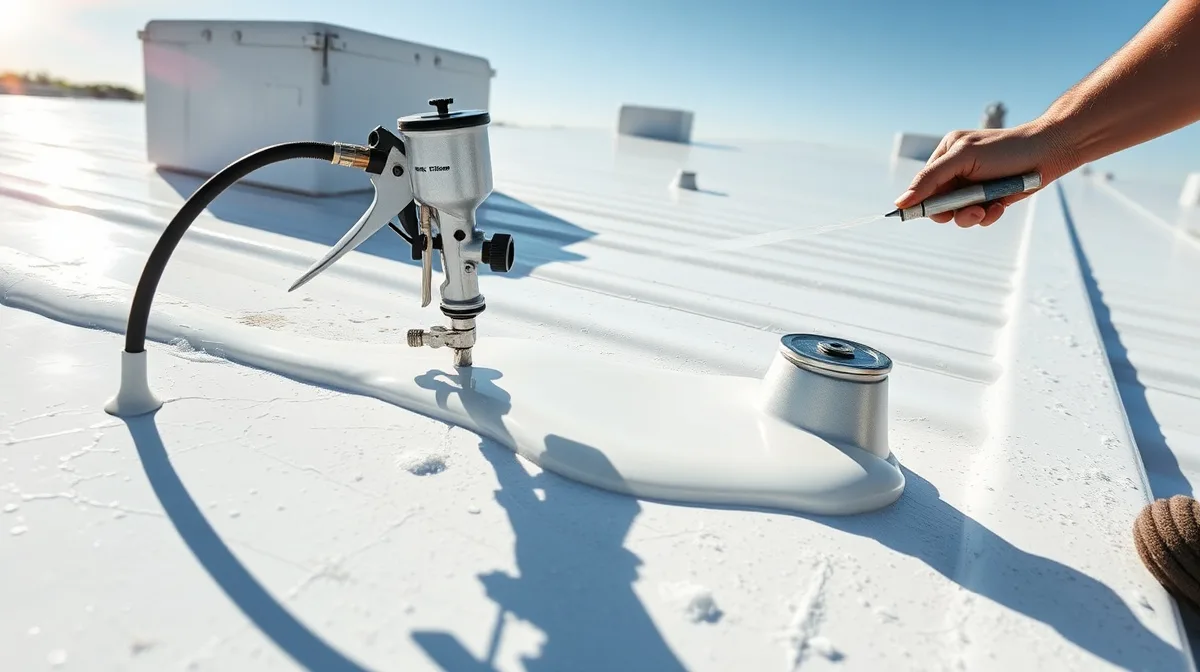
Every SPF roof is only as good as the topcoat protecting it, and in the low desert that topcoat takes a beating most of the country never sees. Roof surface temperatures climb well past 150°F in summer, UV exposure runs near-constant, and the monsoon delivers hard, fast downpours onto flat and low-slope decks that don't always drain instantly. Silicone is the topcoat chemistry built for exactly that combination. Unlike acrylic, which is a water-based coating that can soften, emulsify, or wash thin when it sits under standing water, silicone cures into a rubber-like membrane that stays stable whether it's baking dry for months or holding a puddle after a storm. It's also the most UV-stable coating on the market — it doesn't chalk, crack, or lose its reflectivity the way lesser coatings do after a few Arizona summers.
This page is specifically about silicone as a topcoat choice — a deeper look than our general recoating page, for owners and facility managers who already know they want the strongest UV and ponding-water performance available and want to understand what that actually involves. Silicone gets applied two ways: as a standalone recoat sprayed or rolled directly over an existing, structurally sound foam roof once the old topcoat has thinned or chalked, or as the finish coat on a brand-new SPF system. In either case it's available in bright white for maximum solar reflectance — a genuine "cool roof" upgrade that reduces rooftop surface temperature and eases the cooling load on the building below, on top of the waterproofing job it's already doing. We spray silicone recoats and new silicone topcoats across the Phoenix metro — Scottsdale, Mesa, Tempe, Chandler, Gilbert, Glendale, Peoria, Surprise, Avondale, Goodyear, Queen Creek — as well as Tucson and Casa Grande, and a free on-site inspection is how we confirm whether your roof is a fit before quoting a firm number.
Why property owners choose it
- Silicone resists UV degradation better than any other common roof coating chemistry, so it won't chalk, crack, or yellow after repeated Arizona summers.
- It tolerates standing water that softens or emulsifies acrylic coatings, which matters on the flat, low-slope decks common across Phoenix and Tucson.
- A white silicone topcoat delivers high solar reflectance, lowering rooftop surface temperature and reducing the cooling load on the space underneath.
- It can be applied as a standalone recoat directly over a sound existing foam roof, without a tear-off, to extend the life of the system already in place.
- It cures into a flexible, seamless membrane that moves with the foam substrate through daily heat-cycling instead of splitting at seams or penetrations.
- A properly applied silicone topcoat is what keeps an SPF roof's 40-50+ year lifespan on track by shielding the foam itself from moisture and sun.
UV Stability: Why Silicone Doesn't Break Down Under Arizona Sun
Coating chemistry matters more here than almost anywhere else in the country. Acrylic coatings are a reasonable, lower-cost option in milder climates, but under sustained, intense Arizona UV they chalk, thin, and lose reflectivity noticeably faster than silicone. Silicone's molecular structure is inherently UV-stable — it doesn't rely on additives that break down over time to resist sun exposure, it's simply resistant by nature. That means a silicone topcoat holds its color, its reflectivity, and its protective film thickness longer than acrylic under the same sun load, which directly extends the interval before the next recoat is due.
That durability is exactly what protects the investment underneath it. The foam itself doesn't degrade on its own timeline — it's the coating that takes the UV hit and wears down first, which is why the topcoat is the maintenance item and the foam is the long-term asset. Choosing silicone up front, or switching to it at recoat time, is a direct way to stretch the years between service visits on a roof that's otherwise doing its job. It's also part of what keeps an SPF system's manufacturer warranty intact — most warranties are written around a recoat schedule, and a coating that actually holds its film thickness for the full interval is what keeps that paperwork valid instead of lapsing early.
Ponding Water Resistance on Flat and Low-Slope Roofs
Flat and low-slope roofs are the norm on Arizona commercial buildings and a lot of desert-contemporary residential builds, and even a well-installed, properly tapered foam roof can end up with a low spot or two near a drain after years of settling, or during a hard monsoon downpour that outpaces drainage for a few hours. Acrylic coatings are vulnerable in those spots — prolonged water contact can soften the film and shorten its service life right where it matters most. Silicone is formulated to handle exactly that condition. It resists softening and re-emulsifying under standing water, which makes it the go-to choice for roofs with any known ponding areas or drainage that isn't perfectly ideal.
This isn't a substitute for good tapered slope-to-drain design — we still grade foam to move water off the roof as fast as possible, and a silicone recoat is not a fix for a drainage problem that needs foam re-tapering or a drain relocation. What it does is give you real margin when weather outpaces drainage for a few hours, which during a heavy monsoon system is a realistic scenario on any flat roof in the Valley or in Tucson, and it means an imperfect low spot doesn't turn into a coating failure the way it could under acrylic.
Application: Over Existing Foam, Compatible Substrates, and White Cool-Roof Finishes
A standalone silicone recoat starts with a wash and inspection of the existing roof to confirm the foam underneath is sound, followed by any needed spot repairs before the coating goes down. Silicone is then applied at the mil thickness the roof calls for — typically as a base coat with a topcoat pass, sometimes with a granule or aggregate broadcast in high-foot-traffic areas for slip resistance and added protection. Beyond recoating an existing SPF roof, silicone can also go over other compatible substrates in the right conditions, which we confirm on-site rather than assuming.
Color is a real decision here, not an afterthought. Bright white silicone gives you the highest solar reflectance available and the strongest cool-roof effect, which is worth factoring in even if you don't think of your roof as an energy project — the surface temperature difference on a July afternoon is significant. Tinted and non-white options exist for buildings where a lower-reflectance finish is preferred for aesthetic or code reasons. Recoat pricing on a project like this typically lands in the $3-$5 per square foot range as a starting point, with the specifics driven by thickness, substrate condition, and coverage — a free on-site estimate is how we turn that range into a firm number for your roof.
- Existing spray polyurethane foam roofs due for a recoat
- New SPF systems getting their topcoat as part of initial installation
- Select compatible existing roof substrates, confirmed by on-site inspection
- High-traffic walkways and equipment pads, with granule broadcast for slip resistance
- Bright white for maximum reflectance, or tinted finishes where preferred
Ideal for
- Owners of existing foam roofs whose current topcoat is chalking, thinning, or nearing the end of its recoat interval.
- Flat commercial roofs with drains, scuppers, or low spots that hold standing water after monsoon downpours.
- Property and facility managers who want the longest realistic recoat interval before the next maintenance cycle is due.
- Homeowners and building owners who want a bright white reflective finish to cut attic and roof surface temperatures.
- Any roof where the foam substrate underneath is still structurally sound and just needs a new protective wear layer.
What affects the cost
Silicone Coatings questions, answered
For UV resistance and ponding water tolerance, silicone is the stronger performer in the low desert, which is why we recommend it whenever a roof has any standing water history or when the owner wants the longest possible interval before the next recoat. Acrylic still has a place on budget-conscious jobs with excellent drainage and no ponding, but silicone is the higher-performance choice for most Arizona flat roofs.
Yes, in most cases. If the foam underneath is still structurally sound, a standalone silicone recoat goes right over the existing roof after cleaning, inspection, and any needed spot repairs — no tear-off required. We confirm the foam's condition on-site before recommending a recoat over other options.
Yes. A bright white silicone topcoat reflects a large share of incoming solar radiation instead of absorbing it, which measurably lowers rooftop surface temperature compared to a dark or aged roof. That translates into a lighter cooling load on the space directly below, which matters a lot during Arizona summers.
Silicone topcoats commonly hold up in the 10-20 year range before recoating is needed to keep the system performing and under warranty, often toward the longer end of that range compared to acrylic given its UV and ponding-water resistance. Actual timing depends on coating thickness, sun exposure, and roof condition, which we evaluate at inspection.
Yes, that's one of silicone's defining strengths. Where acrylic coatings can soften or break down under prolonged ponding, silicone is formulated to resist that kind of water contact, making it the preferred choice for roofs with drains, scuppers, or low spots that hold water after monsoon downpours.
Silicone Coatings done right, by a dedicated Arizona SPF crew
Silicone Coatings isn't a commodity — the result depends entirely on how carefully it's planned and applied for your specific property and Arizona's heat-and-monsoon climate. We assess what your roof actually needs, prep the substrate properly, and apply to the depth and tapering your roof requires, so the work delivers the durability and savings it's supposed to. No shortcuts, no builder-grade rush.
We serve the greater Phoenix metro — Scottsdale, Mesa, Tempe, Chandler, Gilbert, Glendale, Peoria, Surprise, Avondale, Goodyear, and Queen Creek — plus Tucson and Casa Grande. Every job starts with a free, no-pressure roof inspection.
Just as important, we treat your roof like the system it is. Substrate condition, foam depth, slope-to-drain tapering, and topcoat selection all interact, and getting one right while ignoring the others leaves durability and savings on the table. When we scope your silicone coatings, we look at how it fits the whole picture — so the finished result performs the way it should, holds up through both 150°F+ summer roof temperatures and monsoon-season downpours, and actually lowers the cooling costs you feel every month. That whole-roof mindset, plus honest advice about what your property truly needs, is what Arizona property owners count on us for.
Free inspection
We evaluate your roof and give you a clear, itemized quote with no pressure.
Expert application
We prep, tape, and apply your silicone coatings to spec — clean and on schedule.
A roof you can trust
A durable, energy-efficient roof and a clear recoat schedule to keep it under warranty.
Related services
Ready for a free silicone coatings quote?
Tell us about your property and we'll put together a clear, no-pressure spray foam roofing quote — commercial or residential, anywhere in the Valley or Tucson.